
Written by Nicole Bayes
Welcome to one of our many new I Can Brain adventures: our world of writing! My team and I have been working hard towards creating a space where we can ponder education through the lens of wellness, all with the purpose of providing support and advice to students, parents, schools and fellow educators.
It is with pride that I find myself writing about the things I care so strongly about: education, mental health, neurodiversity, and of course, I Can Brain – a tutoring and education wellness company that I launched a few years ago.
But, before I get too carried away in this whirl of excitement, let’s talk about how we got here and where we are going!
Happy Accidents
I’ve always enjoyed the idea of ‘happy accidents.’ There is some sort of paradoxical delight that I get from the intertwining of ‘blunder’ and ‘oh that was probably a good thing!’
I’m sure parents, students, as well as my I Can Brain team, have all come across these moments – perhaps you tried a new chicken dish that turned out terribly, making for a humorous (maybe even scarring) family dinner memory – or perhaps your dad forgot to fetch you from school, but you made a new friend with another student whose parents also got the time wrong. We all experience path divergences, and sometimes it’s only when we are several steps along this path that we realise that we have shifted for the better.
My path to education has been one of happy accidents, as I found myself wandering through many different doors in life, mostly due to curiosity (or even boredom!). Teaching occurred by accident, I Can Brain occurred by accident; but in all these happy accidental, even pivotal moments, my journey in creating education wellness is very much intentional.
Can You Brain? I Can Brain.
Whilst teaching for several years both abroad and here, I saw a need in education: comfort in learning, flexibility in learning, and quite simply, a learning that emits kindness. Without the feeling of comfort or love, paired with this persistent rigidity in education, it is no wonder that students, teachers, and parents are struggling with overwhelm – they are simply trying to survive the keep-it-up culture. Add a sprinkle of ADHD, general anxiety, dyslexia, dyscalculia, etc. into the mix, and here we find a space that sustains a can’t-keep-up mindset.
It is within this space that my interest in psychology and the changing adolescent brain led me to recognise the power of language in shaping learner identities, and ultimately their mental health. When I was thinking about starting a company, I searched the depths of my synapses for a name and I remember very clearly saying to myself, “wow, I’m really not braining today!” As an ADHDer myself, that kind of self-talk can perpetuate the ‘I Can’t’ attitude and by noticing it and actively correcting myself, the words, “I can brain” made its debut.
My interest in the brain itself, specifically in neurodiversity and mental health have also contributed significantly to the building of I Can Brain. Further studies around the emotional brain, specifically the prefrontal cortex and the amygdala, highlight a general disconnect between emotions and thought. This is where the symbiotic relationship between education and psychology become highly important – especially when considering adolescent development and the drastic hormonal and social changes they experience.
The fusion of academic and emotional learning is therefore paramount: it is hard to see things when you just don’t feel seen.
It’s important to see those differences. Looking at neurodivergent brains in particular, they tend to have synapses that enjoy playing a bit of broken telephone – which leads to heightened emotions, a feeling of loneliness, and ultimately a lack of confidence. This is why I built I Can Brain around the concept of gentle, personalised learning that looks at who you are and works with your brain to build your confidence and achieve academically. Let that neurodiversity shine!
Neurodiversity: because who wants to be considered typical?
There is this idea of normalising neurodivergence at present, but frankly, neurodiversity is simply brilliance, and that is why it is so identifiable – because who would want to be the same as everyone else? No thanks.
Sadly, the view of neurodiversity isn’t that you are this wonderful sparkle of light, but rather that you have ‘a problem’ or you are one of those very loathsome words such as special, challenged, or behind. This stigma has always been bizarre to me, because it is all driven by looking at the ‘average’ or the ‘middle ground’ – and if you aren’t swimming about there, you are either too much or too little, too fast or too slow.
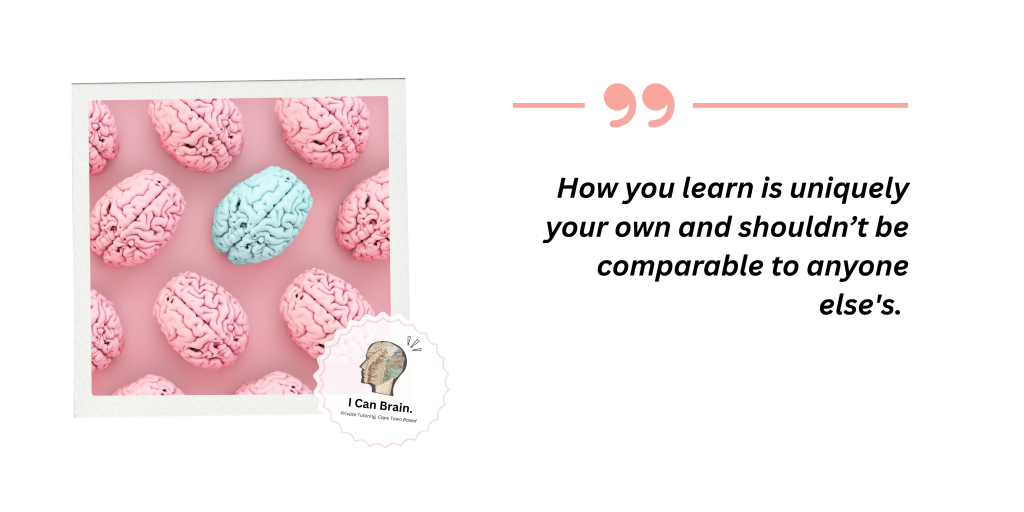
It seems obvious to consider, but think for a moment – what does this do to a learner’s confidence? Everything is built on comparing learners to that infamous spot on a bell curve, but I think that being an ‘outlier’ is far more interesting than striving to be typical. At I Can Brain, we firmly believe that you should learn because you want to – how you learn is uniquely your own and shouldn’t be comparable to anyone else’s.
As someone who stands proudly dressed in ADHD and anxiety, with many years working with neurodivergents, both academically and through a counselling lens, I have a unique perspective on how neurodiversity is typically approached. I’ve seen pure ingenuity and magic in so many learners over the years, but most of these learners and their parents want to cover it all up under a cloak of ‘normalcy.’
As I Can Brain develops and grows, we hope to cultivate an environment of educational wellness that allows everyone to wear their dyslexia hat, their oversized anxiety hoodie, their autism socks, their depression coat — and let me not forget that bright pink fluffy ADHD jacket!
Come August, we will be launching our Education Wellness Counselling Packages and our wellness talks at schools around Cape Town. It is through these exciting projects that we hope to inspire students, parents and educators alike to fold and pack away that cloak of ‘normalcy.’
Our Education Wellness packages, led by our registered and experienced counsellor, Vukile Mexico focus on student wellness — whether through general counselling, support and stress management for Grade 11’s and Matrics, or navigating the emotional changes of the tween years.
Additionally, our wellness talks at schools are built on educating learners about wellness, healthy study methods, and creating an open space to discuss neurodiversity and break down stigmas. Going forward, myself and our Education Support Specialist, Ginn, aim to work with school SBSTs and teachers to build supportive spaces where everyone can brain.
All the Thank You’s
All in all, I continue to exude gratitude and warmth to everyone who has helped build I Can Brain. From my team of tutors, counsellors and development team, through to our learners and parents, all of you have helped to place a building block that has set the foundation for growth.
- Education Meets Wellness: it takes a system to raise a student.
- Panic at the Desk-noooo: Cape Town’s Anxious Education Ecosystem
- Through Their Eyes, I Saw Myself.
- On Being a Teacher, Burnout and Neurospicy Braining
- The Braining of I Can Brain!
I Can Brain.
Private Tutoring, Based in Cape Town
 I Can Brain.
Leave a comment