

Written by Vukile Mexico
The rise of education wellness is changing the way we think about our education system. At the center of this shift are the support systems that connect teachers, families, peers, and counsellors to make sure no student feels left behind. In this article, I’ll explore why these systems are so important and how they can be understood through ecological systems theory.
A strong support system is essential for both students and schools. It ensures that individuals do not face challenges alone, providing stability, guidance, and encouragement. Without this foundation, students may struggle academically and emotionally, highlighting the critical need for comprehensive support systems in education. These interconnected networks (comprising teachers, peers, families, counsellors, and mentors) promote academic success as well as students’ mental health and long-term well-being.
The concept of education wellness is already contributing to huge changes in schools, with more schools taking the step to improve education on mental health. This is a miraculous step because, for
many adults, mental health is a topic we only learned about when we were older, often when it needed intervention. Imagine if we had that knowledge and support?
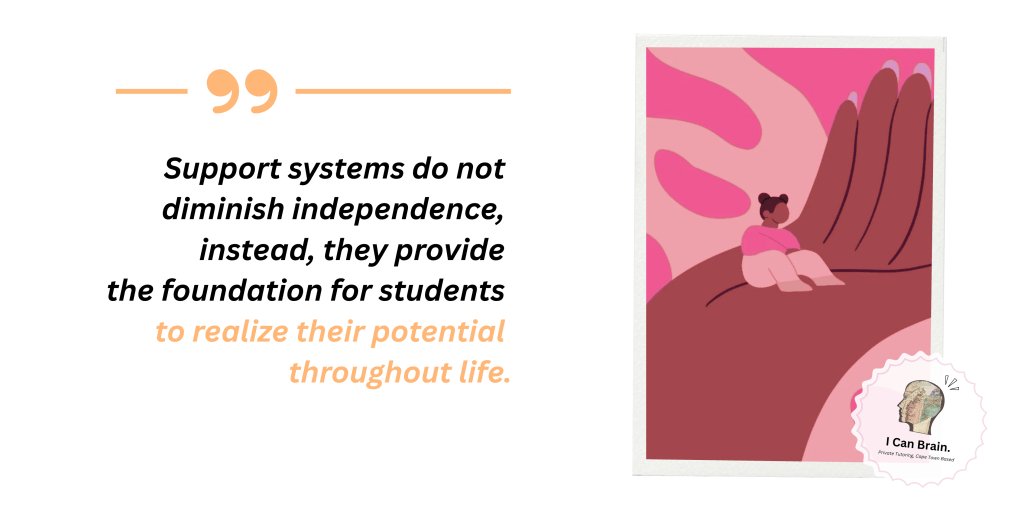
In today’s changing world, it is more crucial than ever for students to have a support system at every level, micro, meso, and macro. These systems foster growth and resilience, helping students navigate challenges into adulthood. Support systems do not diminish independence, instead, they provide the foundation for students to
realize their potential throughout life.
A support system does not have to be perfect to be effective – it will have its flaws. However, for a student going through a difficult time in school or struggling with mental health issues, being able to see support can help bridge the misunderstandings between parents, teachers, and students. The world is evolving, which means humans are evolving with it. It’s time we make education evolve and push education wellness within schools and communities for the benefit of growth.
I believe that taking on a wellness approach in education will prevent so many students from feeling alone and it will show them that they don’t need to do it alone. Often, due to the troubled past of a family, students might feel like, because their parents had to do it solo, they have to do the same. But as I said before, times have changed and with education wellness leading these changes within schools and family units, a sense of community provides us with safety that ultimately leads to confidence in all spheres of life.
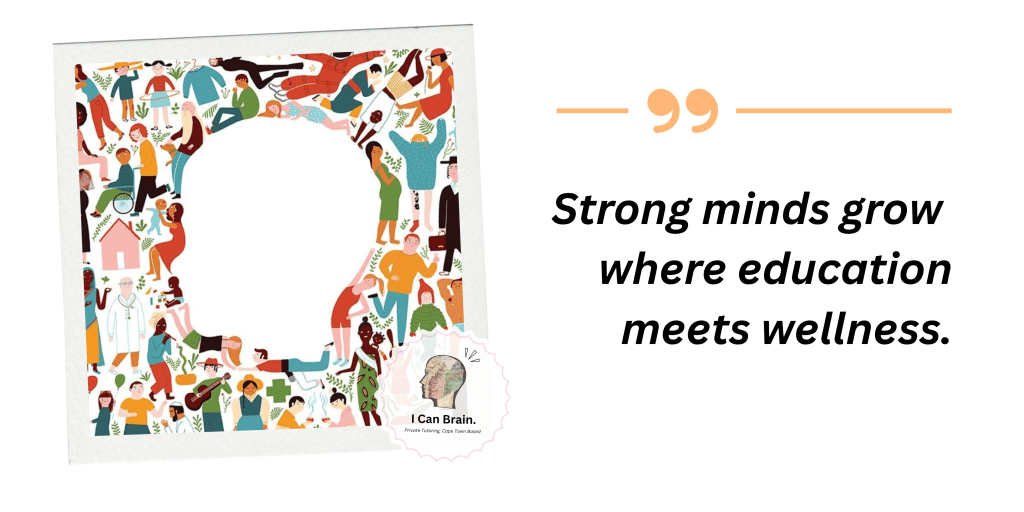
Strong minds grow where education meets wellness. For education to meet wellness though, a support system needs to function, which is where the theoretical approach of ecological systems can help us to zoom in on paper and see how it is possible to achieve.
Education Wellness support through the ecological systems
The reason I want you to explore these systems is to see how easily things can flow when there is a good support system put into place and there is transparency around all parties involved in a student’s life.
In terms of psychology, the idea of education wellness, is rooted in ecological systems theory, which focuses on micro, meso, and macro systems. These systems can be applied to all areas of life and make it easier to understand. So how do those systems apply to education wellness?

- The microsystem: students rely on their immediate relationships, such as family, peers, and teachers. These are the direct supports that help with emotional needs and academic growth.
- The mesosystem: This is the layer of connections
and interactions between different microsystems. This is where home, school, and community come together to form a unified network. - The macrosystem: The outer layer that includes cultural values and societal attitudes. This focuses on how education and wellness are treated and valued within our communities.
So why did I bore you with all this information on systems? It’s simple: these systems form the foundation of of reaching wellness in education, and it shows us how support works on different levels in a student’s life.
To make this clearer, let’s look at a practical example of a student who feels overwhelmed before exams and see how each system plays its role:

This is an example of how easily things can flow when there is a good support system put into place and transparency around all parties involved in a student’s life. The example mentioned above is when everything is following perfectly and all parts of the system are doing their job and functioning well. Unfortunately, that’s not always going to be the case, especially for schools and families with fewer resources or learners who don’t have a certain cog in the support machine available to them. In these situations, there are gaps that could be caused by unsupportive or troubled home environments or schools. This can make the academic and emotional challenges that the student faces a lot harder to deal with. With little or no collaboration between home, school, and community, students will begin to feel isolated and struggle to find guidance.
Without wellness support, student isolation looks like:
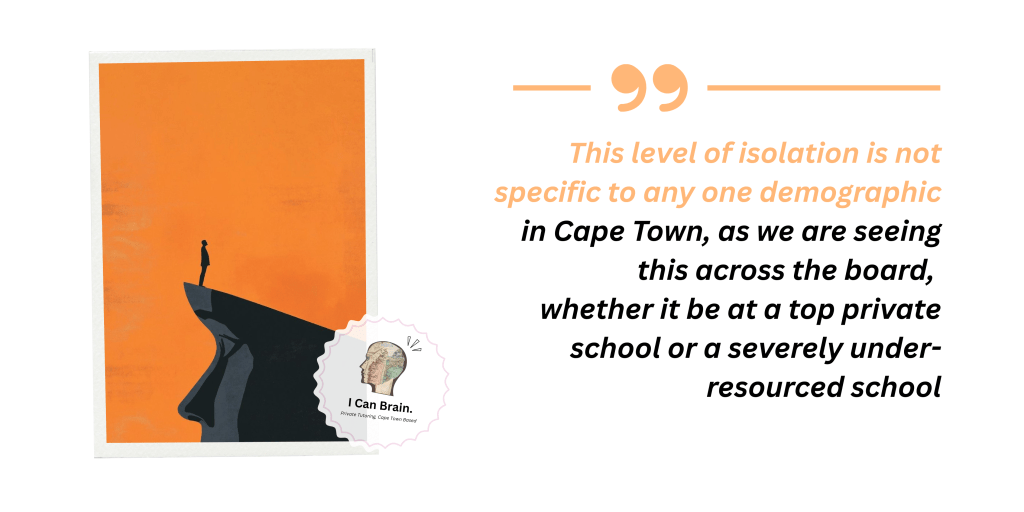
The feeling of being isolated can limit students’ ability to develop life skills like communication, self-confidence, and emotional regulation. This level of isolation is not specific to any one demographic in Cape Town, as we are seeing this across the board, whether it be at a top private school or a severely under-resourced school, when learners don’t feel a part of a larger network of care, they see school as a place where they do not belong. This disconnect can not only make academic challenges harder to overcome but also place their mental health and personal development at risk. Without systems in place, the school environment can unintentionally become a lonely and overwhelming space rather than one of growth and opportunity.
This sense of isolation can manifest in many ways. A student who is battling academic difficulties may start to believe they are “not smart enough” because no one steps in to provide extra support or reassurance. Emotionally, the absence of caring adults or peer support can leave students feeling unmotivated, and misunderstood. In troubled home environments, students may carry unresolved stress into the classroom where it goes unnoticed. Over time, the lack of connection can cause them to withdraw, avoid participation, and lose interest in their education altogether. This is why overall support between systems is imperative.
Solutions to the lack of support systems:
There are many ways to strengthen these systems, but it requires us to start and communicate at each level, (micro, meso and macro) remain patient, and carefully identify the issues as they arise. At the students’ micro level, a useful approach could be to introduce mentorship programs, whether that be through official community programs, or simply seeing a guidance counsellor. Such programs would allow students to connect with adults or older learners who may have faced similar struggles and who can provide both guidance and encouragement. This connection can help them gain a trusted role model who looks out for their well-being and motivates them along the way. For students, having access to a mentor can turn what once felt like distant support into something visible, reachable, and meaningful, not only in their education but also throughout their journey in life.
Peers and trusted adults within the student’s environment also play a crucial role. Positive peer relationships can offer understanding oneself and shared motivation, while trusted adults such as teachers, coaches, tutors or community leaders can provide stability, encouragement, and consistent support. Together, these relationships create a network of care that helps students, not only on their education journey, but also in building confidence throughout their lives. For those who feel support is distant, having mentors, peers, and trusted adults can make it tangible, visible, and truly attainable – it’s a mindset shift. Sports, arts, and cultural programs are a helpful as a way to blow off some steam and create community. So take a look at which part of the system you fit into and how you can create a change in a learners life.
 I Can Brain.
Leave a comment